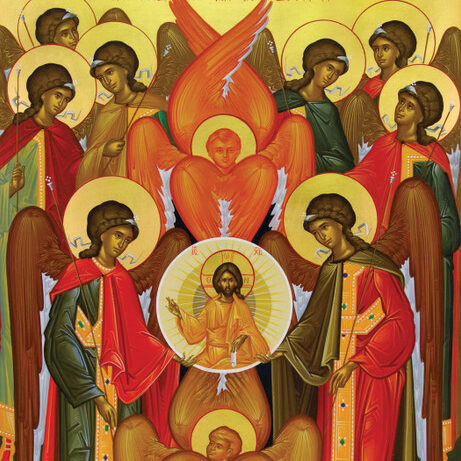
 Lest we come to think of the angels as long since buried in the tomes of old theological treatises, covered over and musty with the dust of the long ages of our indifference, let us turn to our daily, and especially our Sunday worship. Attention to the angels is drawn in many a prayer. The Angelus bell…reminds us of the angelic salutation of the Mother of God. [Western Rite Orthodox] have dedicated the second of October to the commemoration of the guardian angels and keep a day of honor for the archangels Gabriel and Raphael. St. Michael had several feast days over the centuries, but his feast day is now on September 29th. He is, of course, the most popular of the archangels and his is the only feast the Reformers retained.
 This lovely collect,…originally taken from the Sarum Missal…brings out the two most important attributes of the angels found in the Holy Scripture: their service of God in heaven, and their help and protection of men on earth:
O Everlasting God, who hast ordained and constituted the service of Angels and men in wonderful order; mercifully grant that, as thy holy Angels always do thee service in heaven, so, by thy appointment, they may succour and defend us on earth: through Jesus Christ our Lord. Amen.
The Te Deum of Matins [exclaims] “To Thee all angels cry aloud, the heavens and all the powers therein. To thee cherubim and seraphim continually do cry: Holy, Holy, Holy”…
An angelic hymn common to several churches is The Great Doxology, or the Gloria in excelsis, the opening words of which are those sung by the angels when they announced the birth of Jesus Christ to the shepherds at Bethlehem. The whole of it is a kind of shout of praise to the glory of God. Its form is not exactly similar in the East and West, but it is used by both.
There is a prayer to St. Michael…which can well give strength and hearten any soul:
St. Michael the Archangel, defend us in battle, be our protector against the malice and snares of the devil. We humbly beseech God to command him, and do thou, O Prince of the heavenly host, by the divine power thrust into hell Satan and the other evil spirits who roam about the world seeking the ruin of souls. Amen.
Perhaps one of the most beautiful prayers of the [Western] rite is that said immediately after the consecration, asking God to accept the Holy Sacrifice: “We humbly beseech Thee, Almighty God, to command that these things be borne by the hands of Thy
holy angel to thine Altar on High…” When the priest at Mass blesses the incense he prays: “By the intercession of blessed Michael the Archangel, standing at the right hand of the altar of incense, and of all his elect, may the Lord vouchsafe to bless this incense, and receive it as an odor of sweetness…”
These many prayers have the function of sustaining and continually reminding us that the angels never have ceased to have a very real part, an active part, in our worship and also, by invoking them we keep intact our union with them. This has strong Scriptural basis, especially in St. Paul’s doctrine of the Mystical Body of Christ, in which all members have their particular office [Rom.12:4-8] as fellow citizens with the saints, and of the household of God [Eph. 2:19]. The angels’ intermediary attribute of course goes back to the Old Testament.
The Sanctus is sung in [Western and Eastern] Eucharistic rites… For all of us this majestic hymn of praise and thanksgiving is the expression of our exultant gratitude that flows from the depth of heart and soul. It is founded upon the angels’ song heard by Isaiah [6:3] and also upon the hymn with which the Jews welcomed Jesus into Jerusalem [Mt. 21:9-15; Mt. 11:9; Jn. 12:13; and Ps. 117:26]
This, the greatest hymn of praise, is that of the angels; higher than this we cannot ascend, more we cannot express. If we but realized it, as our voices fill the church, we would be conscious that they are picked up by the myriads of angelic voices swelling the song to unearthly volume and carrying it to where the Holy Place of God is. Our voices are but a faint echo of that majestic hymn…
This excerpt from the book, The Holy Angels by Mother Alexandra, describes references in worship to the angels in both the Eastern and Western traditions, which occur in the services of Western Rite Orthodoxy.
Read the full October newsletter here.