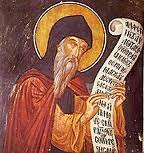
 (Feast Day ~ October 14)
Prayers of Christians in every age have been offered for peace and tranquility, for life free from strife and danger. But when Christians have been faced with danger or oppression, the faithful have remembered Christ’s promise: “Lo, I am with you always, even unto the end of the world” and the Church has flourished.
Following the day of Pentecost when the Apostles preached the Gospel and met martyrdom or exile, the number of believers who were baptized into the Church increased daily. In the next generations, as the Roman state persecuted Christians, a great body of saints – a “cloud of witnesses” – was formed to pray for those who were still in the struggle and to give inspiration to those in years to come.
After peace was established between the Empire and the church by St. Constantine, monasticism provided a new kind of martyrdom for those who sacrificed life in the world and subdued the passions. Once again, the Church flourished – this time in the creative offerings of poets and musicians who adorned our liturgies with songs of praise and thanksgiving. This creative flowering continued as the Church again experienced attack from without (by Muslim or pagan invaders) and within (by heretical movements). On October 14, we remember one of the poet-saints who has given us many beautiful hymns, St. Cosmas, the “Melodist.”
Born around the year 700 in the holy city of Jerusalem, Cosmas was orphaned at an early age, and had to resort to begging in the streets in order to survive. Through the great providence of God, Cosmas was rescued from this fragile existence by a high government official named Sergius. The man took him into his home, introduced him to his own son, John, and decided to formally adopt the orphan boy. Cosmas’ life was forever changed.
Sergius’ family lived in Damascus and, although that city was under Muslim rule and they were devout Christians, Sergius was allowed to maintain his position of authority and respect.
Cosmas and John were provided with a tutor, a monk also named Cosmas, who had been captured in Sicily and brought to Damascus to be sold as a slave. Sergius paid for his freedom and engaged him to teach the two boys. The monk gave them not only the basics of mathematics and literature, but also stirred their hearts to serve God as monastics.
Upon the death of his father, John worked for a while in government, as his father had, but soon both he and Cosmas entered the Monastery of St. Saba outside Jerusalem. Here the talent of each for poetry found expression in hymns for the services of the Church. These hymns began to be sung by the monks and eventually became known and sung in other churches as well.
Patriarch Meletos ordained the monk John to the priesthood first and later also ordained Cosmas and sent him to serve the Christians in Gaza.
St. John of Damascus remained at the Monastery of St. Saba for the remainder of his life, writing theological treatises and hymns, but his adopted brother was made Bishop of Maiuma in Gaza in 743. Even with the busy life of a hierarch serving his flock, Bishop Cosmas continued to write hymns, perhaps inspired by living so near to the events of our Lord’s life. He may have seen the shepherds’ field outside Bethlehem when he wrote:
The shepherds keep their flocks by night, the heaven glows out with wondrous light; the glory of the Lord is there, the Angel bands their King declare; the watchers of the night confessed, “God of our Fathers! Thou art blest.” [#58, St. Ambrose Hymnal]
Perhaps he had traveled as far north as Nazareth and climbed to the top of Mt. Tabor when he composed these words:
In days of old on Sinai the Lord almighty came in majesty and terror, in thunder cloud and flame: on Tabor, with the glory of sunniest light for vest, the excellence of beauty in Jesus was expressed. [#213, St. Ambrose Hymnal]
And he must have venerated the tomb of Christ in Jerusalem and wrote these words in celebration of the Resurrection:
The clouds of night are past away; Mary, rejoice, rejoice to day; the offspring of thy Virgin womb is risen from the Virgin tomb! Alleluia! Alleluia! Alleluia! [#118, St. Ambrose Hymnal]
These hymns and many others continue to be used in Byzantine services, even after 1300 years, and we are grateful to those who have provided translations for use in our Western Rite services.
St. Cosmas died on October 14 in the year 750 and now sings with the heavenly choir, interceding for us before the throne of God. We give thanks for St. Cosmas as we sing his hymns, and we pray that, in times of strife and persecution, the Church will continue to flourish through the witness of her saints.