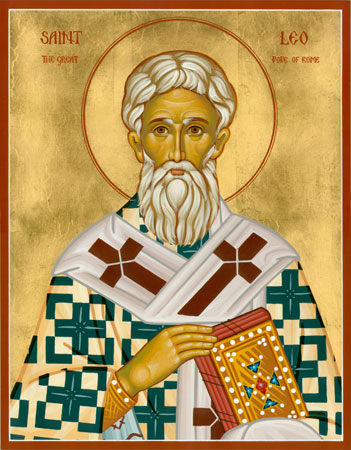
 (Feast Day ~ April 11)
The year 451 was a crucial one for the Church and for one of her saints, Leo, Patriarch (pope) of Rome. In that year, the fourth Ecumenical Council was convened in Chalcedon to continue wrestling with questions regarding the person of Christ, specifically the relationship of his humanity and his divinity.
The previous Council, held at Ephesus only 20 years earlier, had condemned Nestorius (Patriarch of Constantinople) for denying that Christ’s divinity and humanity were united, except in will, thus implying the existence of two persons – one human and one divine. Now, the pendulum swung too far in the opposite direction. An elderly monk of Constantinople, Eutyches – in his zeal to refute the earlier Nestorian heresy – taught that our Lord was not only one person, but that the human and divine were completely fused into one nature. He later compounded his heresy by asserting that there had been two natures before the Incarnation and one after.
Pope Leo was a staunch defender of the Orthodox belief that our Lord and Savior Jesus Christ was one person, of two natures – fully human and fully divine. A Tuscan by birth, Leo had served as a deacon in Rome with Popes Celestine I and Sixtus II. During that time, he corresponded on this subject with Patriarch Cyril of Alexandria, the strongest opponent of Nestorius, and St. John Cassian had dedicated a treatise on the Incarnation to Leo. So when he received the summons to the Council, Leo wrote his own treatise (known as the “tome of Leo”) clearly articulating the Orthodox belief. Leo himself was unable to leave Rome, which was in danger of attack by barbarians, but he sent legates, who were given a place of honor, representing the successor of Peter.
The Bishops and other delegates gathered in the Church of St. Euphemia, with the imperial officers seated in the center and the Book of Gospels in a prominent place. When St. Leo’s tome was read, the bishops all cried, “This is the faith of the Fathers and the Apostles. Peter has spoken through Leo.” After fourteen sessions, the Council ended with the Bishops acknowledging the Orthodox belief concerning the person of Christ by putting their signatures to the Council documents, including St. Leo’s letter.
Meanwhile, back in Rome, St. Leo was called upon to make a defense of a different kind. Since the first sacking of Rome by Alaric the Visigoth in 410, bands of fierce barbarian invaders had swarmed across Italy, Gaul, and Germany, seeking food and land and burning everything in their path. The fiercest of these tribes was that of the Huns, whose cruel leader, Attila, led his army of horsemen on a campaign of destruction, heading for Rome. As there were no imperial forces to protect them, the Pope went out to the city gates, dressed in his vestments, to negotiate with Attila. The barbarian was impressed with the Pope’s bravery, but Leo was also aided in his efforts by Ss Peter and Paul, who appeared to Attila in a vision, standing behind Leo. Attila accepted tribute money and turned away from Leo and Rome, averting a disaster for the people. Two year later, Rome was attacked, this time by the Vandals, and Leo again negotiated to save the city from complete destruction.
Many letters and sermons of St. Leo survive to this day, and these documents provide us with a picture of his loving care of his flock and with invaluable evidence of the Western Orthodox liturgical practices of his time. He is believed to be the author of some of the prayers in the Sacramentary which is named for him (the “Leonine Sacramentary”).
After serving as Pope for twenty years, St. Leo, near death, spent his last days praying before the tomb of St. Peter. He entered into rest in the year 461 and we honor his blessed memory on April 11. May God give us wisdom and strength, through the intercession of holy Leo, to keep and defend the Orthodox faith.